“You are never too old to set another goal or to dream a new dream.” ~ C.S. Lewis
Every Child Is One‑of‑a‑Kind
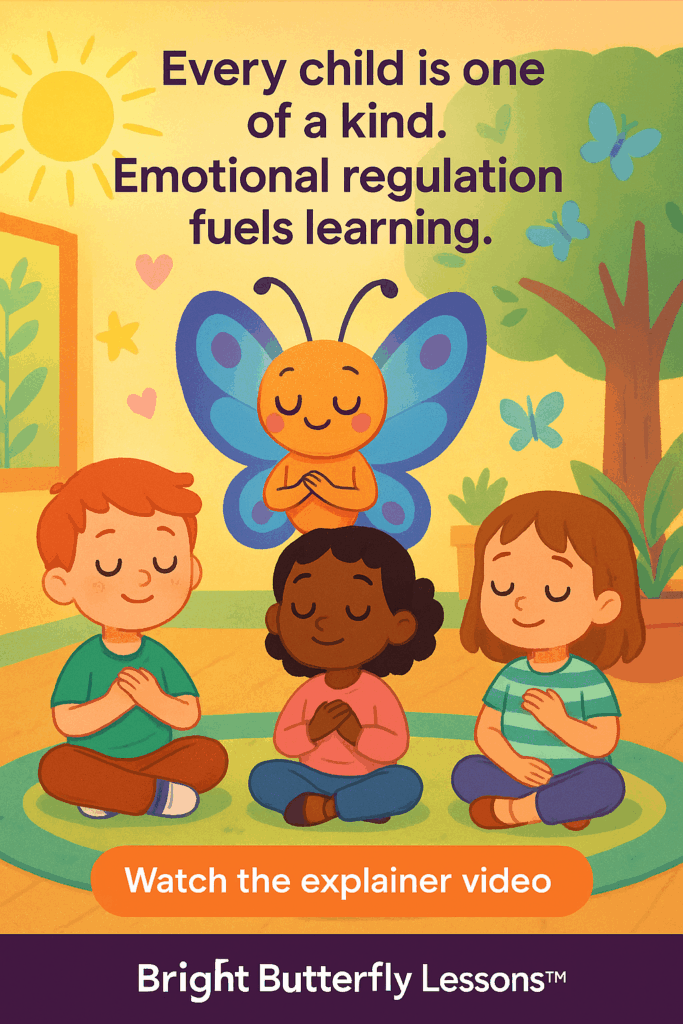
Long before children tackle algebra or adverbs, they are learning how to recognize a flutter of frustration, take a breath, and choose a helpful next step. When young learners understand that they are important, one of a kind, and have a special gift to share, emotional regulation skills become tools for letting that gift shine.
1. How Self‑Regulation Super‑Charges Focus & Retention
The Impact of Self-Regulation on Cognitive and Academic Performance:
Large‑scale studies confirm the link: preschoolers with stronger emotion regulation skills score significantly higher on later reading and math assessments, even after controlling for IQ and family background PMCFrontiers. In other words, social emotional learning in preschool doesn’t steal instructional minutes—it multiplies their impact.
| Classroom Challenge | What Self‑Regulation Does | Resulting Learning Outcomes |
| Wandering attention | Lowers stress hormones aka cortisol; keeps the prefrontal cortex “online.” | Longer on‑task time and deeper encoding of new information. |
| Memory overload | Calms the limbic system so working‑memory “space” stays clear. | Stronger recall during literacy and math tasks. |
| Impulsive reactions | Boosts inhibitory control and flexible thinking. | Better problem‑solving and cooperative work. |
2. Why Schools Are Investing Now
- Measurable Academic Gains: Programs that explicitly teach EI/EQ competencies raise achievement by an average of 11 percentile points CASEL.
- Return on Instruction (ROI): Economists calculate an 11:1 return for every dollar invested in evidence‑based Social Emotional Learning (SEL)—savings from reduced behavior incidents, special‑service referrals, and teacher turnover CASEL.
- System‑Wide Adoption: By the 2023‑24 school year, 83 percent of U.S. principals reported using a social‑emotional curriculum, up from 46 percent in 2017‑18 CASEL. Districts now view emotion regulation schools initiatives as essential infrastructure, not enrichment.
👉 Watch our short explainer video now:
🌐 www.BrightButterflyLessons.com
3. Brightly: Turning Science Into Butterfly Wings for Ages 3‑6
Bright Butterfly Lessons™ delivers bite‑sized, WCAG 2.2 AA‑compliant episodes that pair neuroscience with play:
| Lesson Stage | Butterfly Metaphor | Skill Highlight |
| Egg | Every tiny egg holds unique potential. | Growth mindset—“I can learn anything.” |
| Caterpillar | Constant nibbling = healthy habits. | Happiness practices & gratitude walks. |
| Pupa | Stillness before change. | Mindfulness breathing & body scans. |
| Chrysalis | Safe space for transformation. | Resilience tools (tapping, heart‑focus). |
| Butterfly | Spread your one‑of‑a‑kind wings. | Dream‑building & kindness missions. |
Pilots in Denver Public Schools recorded calmer classrooms, sharper focus, and noticeable spikes in kindness within one week of implementation—evidence that when children feel valued and empowered, their academic engines rev more efficiently.
From “Nice‑to‑Have” to Core Curriculum
Emotion regulation is not fluff; it is the yeast that makes academic dough rise. By teaching every child—especially our youngest—that they matter, are unmistakably unique, and possess a gift the world truly needs, we open the neurological gateway to stronger learning outcomes, healthier relationships, and a brighter future for all.
Love this! What a valuable resource to give young children!